Minecraft Trial Chambers: Everything You Need to Know
Minecraft Trial Chambers are one of the most interesting underground structures added with the Tricky Trials update. Unlike traditional structures that mainly reward exploration, Trial Chambers are designed around combat challenges, exploration, traps, and valuable rewards.
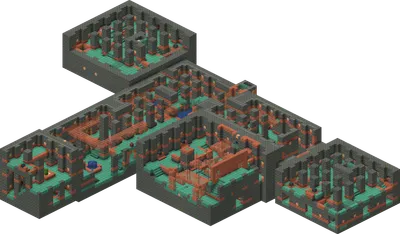
Deep underground in the Overworld, players can discover large networks made primarily from Copper and Tuff blocks. Inside, you’ll encounter procedurally generated rooms, Trial Spawners, Breeze encounters, Vaults, hidden loot, and optional Ominous challenges.
Whether you’re exploring your first Trial Chamber or trying to collect its rarest rewards, this guide covers everything you need to know.
What Are Trial Chambers in Minecraft?
Trial Chambers are underground structures introduced in Minecraft 1.21 as part of the Tricky Trials update.
They are different from structures such as villages, temples, and Woodland Mansions because much of the experience revolves around combat challenges. Instead of simply finding a chest and leaving, players have to navigate rooms and activate Trial Spawners that create controlled waves of hostile mobs.
The layout is procedurally generated, so two Trial Chambers can look very different from each other.
Trial Chambers can contain:
- Trial Spawners
- Ominous Trial Spawners
- Vaults
- Ominous Vaults
- Breeze encounters
- Copper and Tuff structures
- Decorative Pots
- Supply areas
- Traps
- Various combat rooms
- Valuable loot
Natural mob spawning does not normally occur inside Trial Chambers, making their combat system different from ordinary caves.
Where Do Trial Chambers Generate?
Trial Chambers generate underground in the Overworld, generally around the Deepslate layer.
They can generate in different sizes and have procedurally generated layouts. A chamber can contain multiple interconnected rooms, corridors, intersections, combat areas, and decorative sections.
An important detail is that Trial Chambers do not start inside a Deep Dark biome, although their structure can sometimes overlap one.
Because they generate underground, you may encounter Trial Chambers while exploring caves or digging through underground areas.
How to Find a Trial Chamber
There are several ways to locate Trial Chambers.

1. Explore Underground
The traditional method is simply exploring the underground Overworld.
Because Trial Chambers generate around the deeper underground layers, exploring large cave systems can eventually lead you to one.
However, randomly searching can take a long time.
2. Use a Trial Explorer Map
A more convenient method is obtaining a Trial Explorer Map from a Journeyman-level Cartographer.
The map can point you toward a nearby Trial Chamber, making it much easier to locate one without spending hours searching underground.
3. Use Commands
If commands are enabled in your world, you can use Minecraft’s structure-location command to locate structures.
For example:
/locate structure minecraft:trial_chambersThe exact command availability and behavior can depend on the Minecraft edition and version you’re playing, so check your current version if the command doesn’t work.
4. Use a Seed and Structure Finder
If you’re planning a survival world around Trial Chambers, you can also use a Minecraft seed-based structure finder to identify their locations.
For normal survival exploration, however, the Trial Explorer Map is the intended in-game method.
What Do Trial Chambers Look Like?
Trial Chambers have a distinctive underground appearance.
Their architecture heavily uses:
- Copper blocks
- Copper grates
- Copper doors
- Tuff blocks
- Tuff variants
- Stone-related blocks
- Decorative elements
Large corridors connect different rooms, while intersections and combat areas can contain traps, Trial Spawners, and other challenges.
The procedural generation system means you shouldn’t expect every Trial Chamber to have exactly the same layout.
Some areas may be relatively open, while others can contain narrow corridors and more complicated combat spaces.
Trial Chamber Layout and Rooms
One of the best things about Trial Chambers is that exploration isn’t completely predictable.
A chamber can contain different types of rooms and pathways, including:
Combat Rooms
These areas contain Trial Spawners that activate when players enter their detection range.
Corridors
Corridors connect different parts of the structure and may contain decorative elements, supplies, or hidden areas.
Intersections
Intersections can lead toward several different rooms and may contain additional challenges.
Breeze Areas
Certain specially designed rooms contain Trial Spawners associated with the Breeze.
Vault Areas
Vaults are placed throughout Trial Chambers and provide another reason to explore areas beyond the first combat encounter.
What Is a Trial Spawner?
The Trial Spawner is the central mechanic of Trial Chambers.
Unlike a normal Minecraft mob spawner, a Trial Spawner doesn’t simply produce an unlimited stream of mobs.
Instead, it creates a controlled combat challenge.
When players approach an active Trial Spawner, it can begin spawning hostile mobs based on the category assigned to that particular spawner.
Once the challenge is completed, the Trial Spawner provides rewards and enters a cooldown period.
Official Minecraft information states that Trial Spawners enter a 30-minute cooldown after their rewards are ejected.
Trial Spawner Mob Types
Trial Spawners can use different mob categories.
Melee
Possible melee mobs include:
- Zombie
- Husk
- Spider
Small Melee
Possible small-melee mobs include:
- Slime
- Cave Spider
- Baby Zombie
- Silverfish
Ranged
Possible ranged mobs include:
- Skeleton
- Stray
- Bogged
The exact combination is randomized when a Trial Chamber generates.
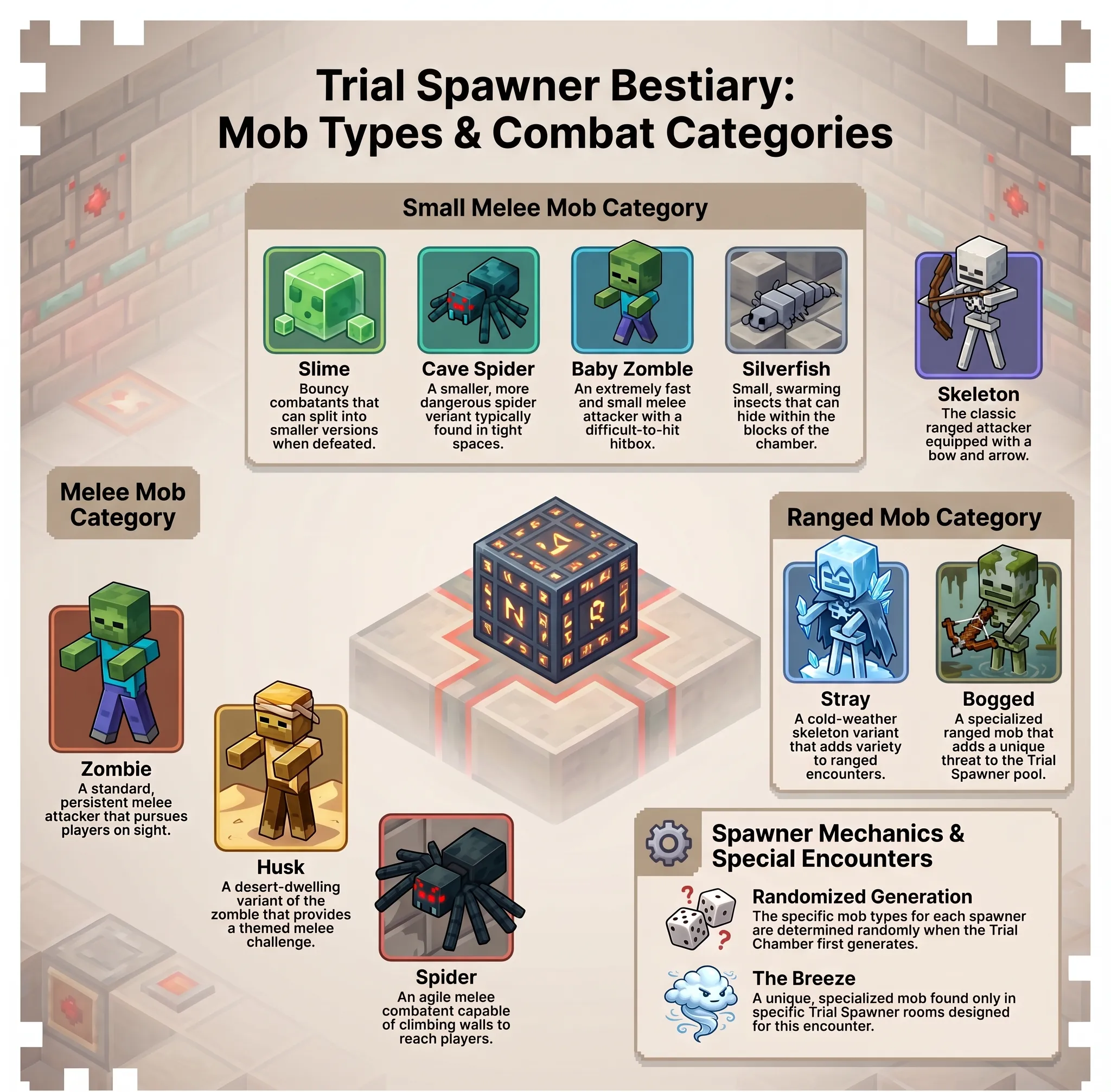
Some specialized rooms have Trial Spawners associated with the Breeze.
How Trial Spawner Challenges Work
Trial Spawners are designed around a challenge rather than ordinary mob farming.
After activation, mobs appear around the player and have to be defeated.
The challenge level can affect the number of mobs that appear.
Once all required mobs have been defeated, the Trial Spawner ejects rewards.
After that, the spawner enters its cooldown period.
This system makes each Trial Chamber feel more like a dungeon encounter than a normal cave.
What Is the Breeze?
The Breeze is a hostile mob strongly associated with Trial Chambers.
It uses wind-based attacks and can make certain rooms considerably harder to navigate.
The Breeze is particularly interesting because its attacks interact with the environment and can push players around.
Defeating Breeze mobs can also provide Breeze Rods, which are useful for crafting items such as Wind Charges.
The Breeze was introduced alongside Trial Chambers in Minecraft 1.21.
What Are Vaults in Trial Chambers?
Vaults are special blocks found throughout Trial Chambers that contain valuable randomized rewards.
Unlike a normal chest, a Vault requires a Trial Key to unlock.
Vaults were specifically designed to make multiplayer exploration more rewarding because different players can unlock the same Vault individually. Once a player has opened a particular Vault, that player cannot open that same Vault again.
This means finding a Vault doesn’t necessarily mean another player has already taken your reward.
How to Open a Vault
To open a standard Vault:
- Find a Vault inside the Trial Chamber.
- Complete Trial Spawner challenges.
- Obtain a Trial Key.
- Approach the Vault.
- Use the Trial Key on it.
- Collect the randomized reward.
A Vault can be unlocked by multiple players, but each individual player can only claim its reward once.
This makes Vaults especially useful when exploring Trial Chambers with friends.
What Is a Trial Key?
A Trial Key is an item used to unlock standard Vaults.
Trial Keys can be obtained as rewards from Trial Spawners.
They are an important part of the Trial Chamber progression loop:
Trial Spawner → Combat Challenge → Reward → Trial Key → Vault → Loot
This encourages players to continue exploring rather than simply entering the structure and leaving.
What Are Ominous Trials?
Ominous Trials are a harder version of the standard Trial Chamber experience.
They are intended for players who want more difficult challenges in exchange for access to different and more valuable rewards.
The Ominous system is connected to the Bad Omen mechanic, which can transform into Trial Omen when the player comes within range of a suitable Trial Spawner.
When the conditions are met, the Trial Spawner can become an Ominous Trial Spawner.
Ominous Trial Spawners
Ominous Trial Spawners are more challenging versions of normal Trial Spawners.
They have several visual differences, including:
- Blue flames
- Soul-fire effects
- More difficult combat encounters
- Additional projectile and potion effects
- Stronger equipped mobs in relevant encounters
The mobs produced by an Ominous Trial Spawner can be more difficult than those found in a normal trial.
After completing an Ominous challenge, the spawner provides a different reward set from a standard Trial Spawner.
What Is an Ominous Vault?
An Ominous Vault is a special Vault associated with Ominous Trials.
These Vaults are usually placed in harder-to-reach locations and require an Ominous Trial Key.
Their reward pool contains items that are not available from standard Vaults.
Examples of notable Ominous Vault rewards include:
- Heavy Core
- Enchanted Golden Apple
- Flow Armor Trim Smithing Template
- Flow Banner Pattern
- Powerful Mace enchantments
- Higher-level Ominous Bottles
The exact loot tables can vary by Minecraft version, so always check the loot behavior for the version you’re playing.
How to Get an Ominous Trial Key
An Ominous Trial Key is obtained from an Ominous Trial Spawner.
According to the official 1.21 documentation, an Ominous Trial Spawner has a 30% chance to eject an Ominous Trial Key when defeated.
Once you obtain one, you can use it to unlock an Ominous Vault.
Trial Chamber Loot
Trial Chambers aren’t only about combat. Their rewards are one of the biggest reasons players explore them.
Depending on the Vault and current Minecraft version, rewards can include items such as:
- Enchanted equipment
- Enchanted Books
- Trial-related items
- Armor Trim Smithing Templates
- Banner Patterns
- Ominous Bottles
- Heavy Core
- Other valuable resources
Ominous Vaults have a different and generally more specialized loot pool.
The Heavy Core is particularly notable because it is connected to the Mace crafting progression.
What Is the Heavy Core?
The Heavy Core is a rare item associated with Trial Chamber progression.
It is found through the Ominous Vault loot system and is used together with a Breeze Rod to craft the Mace.
Because of its rarity and its connection to one of Minecraft’s newer weapons, the Heavy Core is one of the major reasons experienced players may want to complete Ominous Trials.
Best Items to Bring to a Trial Chamber
Before entering a Trial Chamber, preparation matters.
A useful exploration setup should include:
- Strong armor
- A reliable melee weapon
- A ranged option
- Plenty of food
- Blocks for navigation
- Torches or another way to mark routes
- A shield
- Water where appropriate
- Spare tools
- Extra inventory space
You don’t want to fill your inventory before reaching the Vaults because Trial Chambers can provide many different items during a single exploration session.
Tips for Exploring Trial Chambers
1. Mark Your Route
Trial Chambers can become confusing because of their interconnected rooms.
Use blocks or other visual markers to remember where you’ve already been.
2. Don’t Rush Into Every Room
Take a moment to observe the room before moving toward a Trial Spawner.
Understanding the surroundings can make combat much easier.
3. Keep Your Inventory Organized
Leave unnecessary items at home.
You want enough space for Trial Keys, loot, resources, and unexpected rewards.
4. Watch Your Surroundings
Some areas contain traps or difficult combat situations.
Don’t focus exclusively on the mobs directly in front of you.
5. Search Beyond the First Vault
The first Vault you find isn’t necessarily the end of the structure.
Explore additional corridors and rooms to find more challenges and rewards.
6. Prepare Before Ominous Trials
Ominous Trials are significantly more demanding than ordinary Trial encounters.
Make sure you’re properly equipped before intentionally activating them.
Trial Chambers in Java vs Bedrock
Trial Chambers are available in both Minecraft Java Edition and Minecraft Bedrock Edition as part of Minecraft 1.21 and later versions.
The overall structure and major mechanics are shared:
- Trial Chambers
- Trial Spawners
- Vaults
- Ominous Trials
- Breeze
- Bogged
- Trial Keys
- Ominous Trial Keys
However, individual mechanics, commands, technical behavior, or loot details can change between versions and updates.
If you’re writing a guide for a specific Minecraft version, it’s a good idea to mention that version rather than assuming every future update will behave identically.
Are Trial Chambers Rare?
Trial Chambers are not designed to be extremely rare structures like some of Minecraft’s most difficult-to-find locations.
They can generate relatively commonly through the deeper underground layers of the Overworld.
The bigger challenge is usually finding a convenient entrance and navigating the structure, rather than the structure being impossibly rare.
A Trial Explorer Map can make locating one significantly easier.
Can Trial Chambers Be Reset?
Trial Spawners have a cooldown after completing their challenge.
Official Minecraft documentation specifies a 30-minute cooldown for a normal Trial Spawner after it finishes its reward sequence.
This means you shouldn’t think of Trial Chambers as ordinary mob farms that constantly produce enemies.
Their mechanics are designed around periodic combat challenges.
Can You Find Multiple Vaults in One Trial Chamber?
Yes.
Trial Chambers can contain multiple rooms and multiple Vaults.
Because the layout is procedurally generated, the exact number and placement of Vaults can differ between structures.
This is one reason it is worth exploring the entire chamber instead of leaving after finding the first reward.
Are Trial Chambers Worth Exploring?
For players who enjoy exploration and combat, Trial Chambers offer a different type of Minecraft dungeon experience.
They combine:
- Underground exploration
- Procedural layouts
- Combat challenges
- New mobs
- Vault-based rewards
- Keys
- Optional harder challenges
- Rare items
The biggest attraction is that you aren’t simply opening a chest. You have to actively progress through the structure and complete challenges to access some of its most interesting rewards.
FAQ’s
How do you find a Trial Chamber in Minecraft?
You can find Trial Chambers by exploring the deep underground Overworld or by using a Trial Explorer Map obtained through a Cartographer. Commands can also be used in worlds where commands are enabled.
What version added Trial Chambers?
Trial Chambers were officially added in Minecraft 1.21, the Tricky Trials update.
What mobs spawn in Trial Chambers?
Depending on the Trial Spawner category and generated chamber, you can encounter mobs such as Zombies, Husks, Spiders, Slimes, Cave Spiders, Baby Zombies, Silverfish, Skeletons, Strays, Bogged, and Breeze encounters.
What is the rarest Trial Chamber loot?
The loot available depends on the Vault type and Minecraft version. Notable rare rewards include the Heavy Core and other specialized Ominous Vault rewards.
What key opens a Trial Chamber Vault?
A normal Vault requires a Trial Key. An Ominous Vault requires an Ominous Trial Key.
Can other players open the same Vault?
Yes. A Vault can provide rewards to multiple players, but an individual player cannot claim the same Vault’s reward more than once.
What is the difference between a Trial Spawner and a normal Spawner?
A normal Minecraft spawner can continuously produce mobs under its spawning conditions. A Trial Spawner instead creates a controlled combat challenge, rewards players after the challenge, and then enters a cooldown period.
What is an Ominous Trial?
An Ominous Trial is a harder version of the Trial Chamber challenge that uses Ominous Trial Spawners and provides access to different rewards.
Can Trial Chambers generate under other structures?
Because Minecraft’s world generation is procedural, structures can interact or overlap in unusual ways. Trial Chambers can also overlap certain underground areas, including Deep Dark terrain, although they do not start inside a Deep Dark biome.
Final Thoughts
Minecraft Trial Chambers added a completely different style of exploration to the Overworld.
Instead of simply searching for a chest, players have to move through procedurally generated rooms, deal with Trial Spawners, defeat different mobs, collect Trial Keys, and locate Vaults. Players who want an even greater challenge can take on Ominous Trials and search for Ominous Vaults.
The combination of combat, exploration, randomized layouts, and reward progression makes Trial Chambers one of the most important underground structures introduced in Minecraft 1.21.


![8 Best Minecraft Seeds With Incredible Spawns [1]](https://brgamers.online/wp-content/uploads/2026/09/minecraft-best-seeds--1024x576.webp)