Food is an essential part of Minecraft’s survival system. Players need food to restore hunger, maintain saturation, recover health naturally, sprint, explore, and survive long journeys. Food items can be obtained through farming, hunting animals, fishing, trading, crafting, and exploring generated structures.
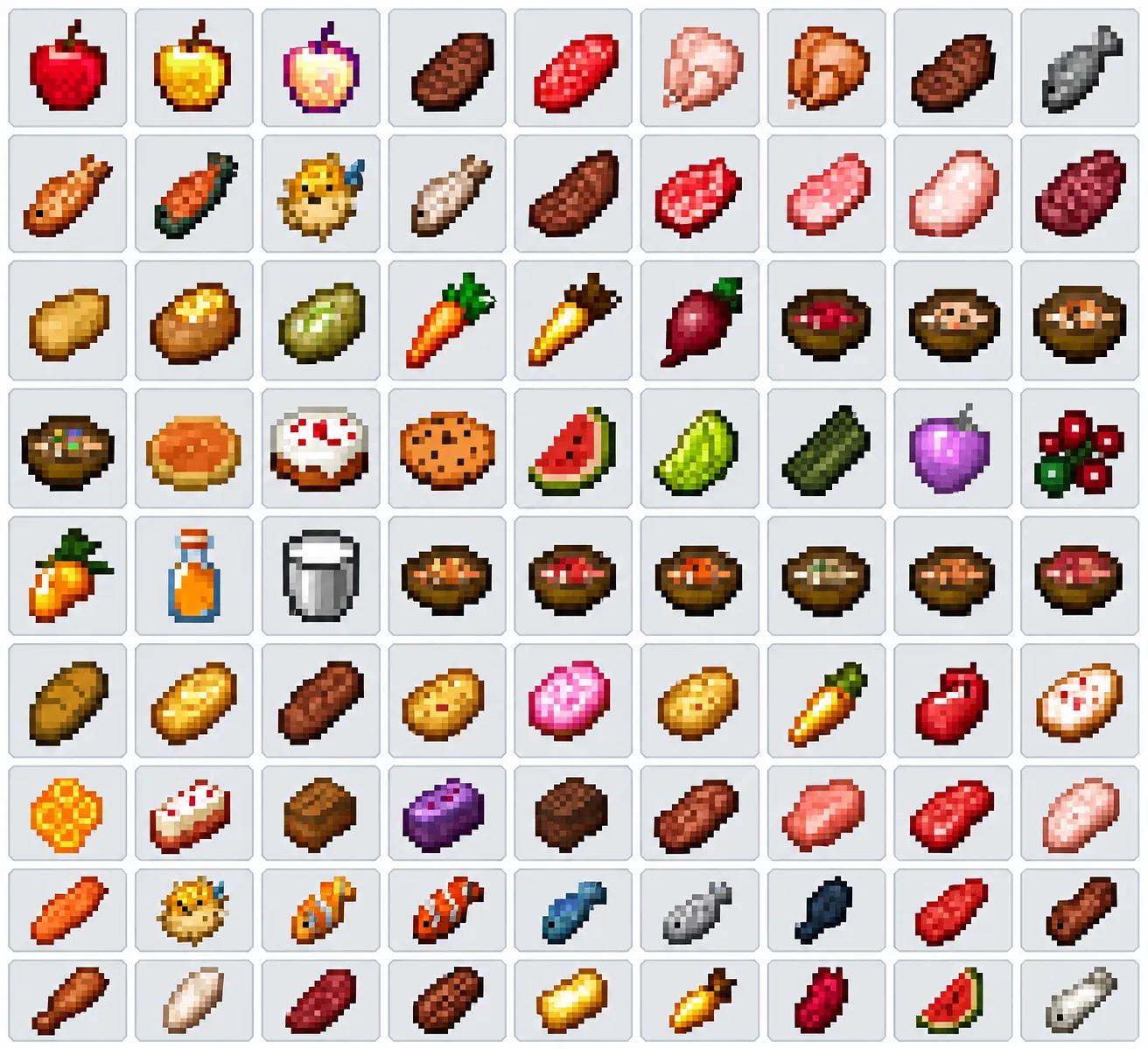
Most food items are eaten by selecting them in the hotbar and holding the use button. However, some foods work differently. For example, Cake must be placed as a block before it can be eaten.
Hunger Bar

The hunger bar contains 20 hunger points, displayed as 10 drumsticks. Eating food restores a specific number of hunger points depending on the item.
Hunger affects several survival mechanics:
- Natural health regeneration stops when hunger falls below 18 points.
- Sprinting becomes unavailable when hunger reaches 6 points or lower.
- Starvation damage begins when the hunger bar reaches 0.
- On Easy difficulty, starvation cannot reduce health below 10 points.
- On Normal difficulty, starvation cannot reduce health below 1 point.
- On Hard and Hardcore difficulty, starvation can eventually kill the player.
Hunger and Saturation
Minecraft uses two main food values: hunger and saturation.
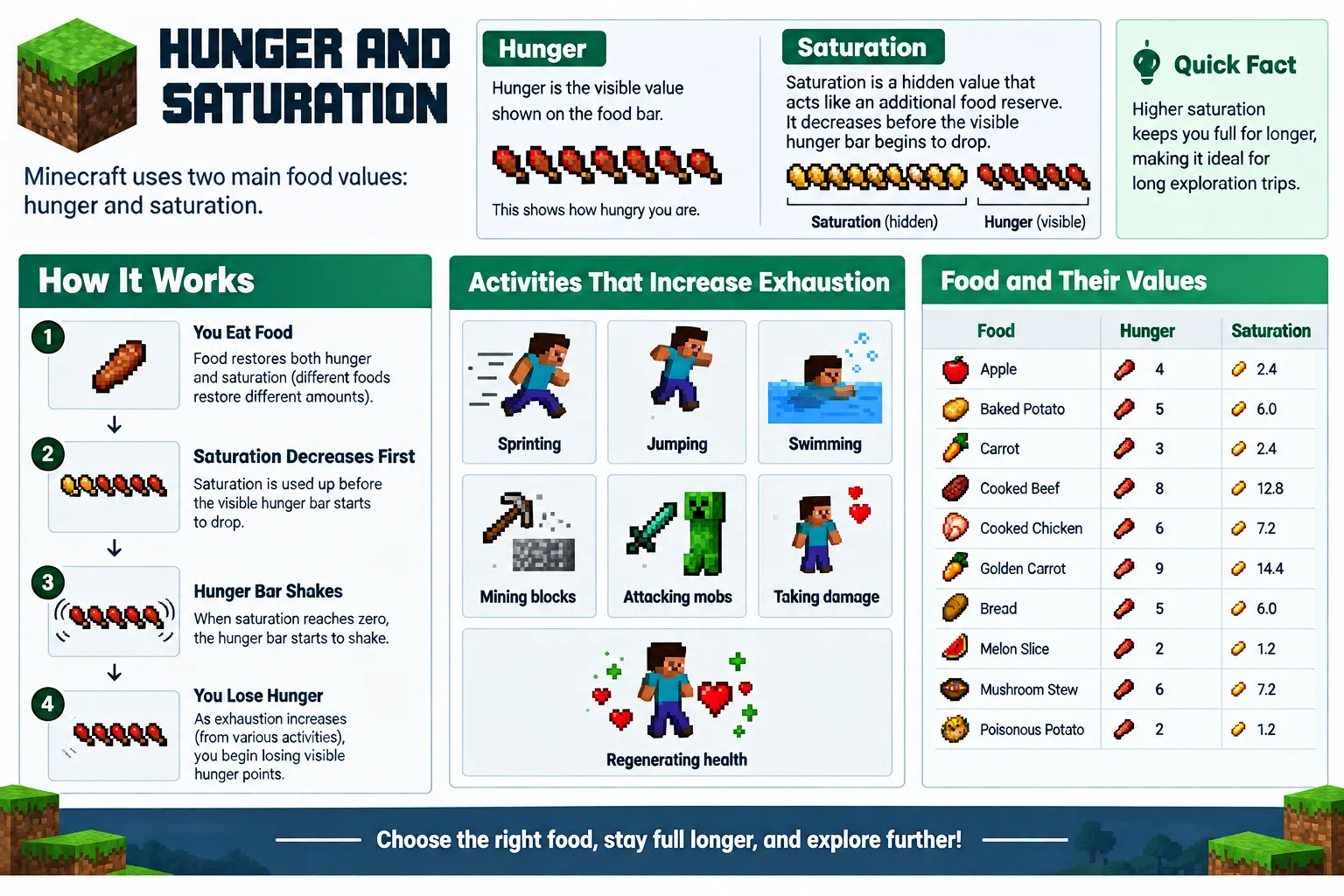
Hunger is the visible value shown on the food bar. Saturation is a hidden value that acts like an additional food reserve. Saturation decreases before the visible hunger bar begins to drop.
When saturation reaches zero, the hunger bar starts to shake. The player then begins losing visible hunger points as exhaustion increases through activities such as:
- Sprinting
- Jumping
- Swimming
- Mining blocks
- Attacking mobs
- Taking damage
- Regenerating health
Different foods restore different amounts of hunger and saturation. Foods with high saturation are generally better for long exploration trips because they keep the player full for longer.
Food Points and Saturation
Food points are measured in hunger points. One full drumstick represents 2 hunger points.
For example:
- Bread restores 5 hunger points.
- Baked Potato restores 5 hunger points.
- Cooked Beef restores 8 hunger points.
- Cooked Porkchop restores 8 hunger points.
- Golden Carrot restores 6 hunger points but provides very high saturation.
Food also has a nourishment value, which describes how much saturation it restores compared with the hunger points provided. Foods with higher nourishment are more efficient when the hunger bar is already relatively full.
Best Foods for Survival
Cooked Beef and Cooked Porkchop are excellent everyday foods because they restore 8 hunger points and provide strong saturation. They are especially useful for mining, combat, and exploration.
Golden Carrots are among the best foods for saturation. They are expensive because they require gold, but they are highly effective for long journeys and difficult battles.
Baked Potatoes are easy to produce in large quantities and are a dependable food source for early and mid-game survival.
Bread is simple to craft from wheat and is useful when players have access to a wheat farm.
Cooked Chicken is easy to obtain if the player has a chicken farm, although it provides less hunger and saturation than steak or cooked porkchop.
Raw Food and Cooked Food
Many raw meat items can be cooked in a Furnace, Smoker, or Campfire. Cooked meat usually restores more hunger and saturation than its raw version.
Raw food can sometimes have negative effects:
- Raw Chicken has a chance to give the Hunger effect.
- Rotten Flesh has a high chance of giving the Hunger effect.
- Pufferfish gives several harmful status effects and should not be used as a normal food source.
Cooking meat before eating it is generally safer and more efficient.
Food Sources
Players can obtain food in several ways:
- Growing wheat, carrots, potatoes, beetroot, and other crops
- Breeding and hunting animals
- Fishing
- Trading with farmer villagers
- Finding food in naturally generated chests
- Crafting soups, bread, cakes, and other prepared foods
- Collecting apples from oak and dark oak leaves
- Harvesting sweet berries and glow berries
Creating farms is one of the best ways to maintain a reliable food supply. Animal farms provide meat, while crop farms provide renewable ingredients for bread, baked potatoes, and other foods.
Special Food Items
Some food items have unique properties:
- Golden Apples: Provide Absorption and Regeneration effects.
- Enchanted Golden Apples: Give powerful temporary effects and cannot be crafted normally in modern survival gameplay.
- Chorus Fruit: Can be eaten even when the hunger bar is full and may teleport the player randomly.
- Honey Bottles: Remove Poison and can be consumed even when hunger is full.
- Suspicious Stew: Restores hunger and provides different status effects depending on the flower used.
- Cake: Contains multiple slices and must be placed before eating.
- Milk: Removes active status effects but does not restore hunger.
Food Management Tips
Carry a sufficient amount of food whenever you enter caves, the Nether, the End, or unfamiliar areas. High-saturation foods are best for long trips, while easily obtainable foods such as bread and baked potatoes are useful for regular survival.
Avoid eating when the hunger bar is nearly full if the food would waste hunger or saturation points. Keep special foods such as Golden Apples for emergencies, difficult fights, or situations where their effects are particularly useful.
A dependable food supply is just as important as tools, armor, and weapons. Choosing suitable food helps players maintain health, move efficiently, and survive longer in Minecraft.


Pingback: Frozen Shipwreck and a Village – Minecraft Seed for 26.X